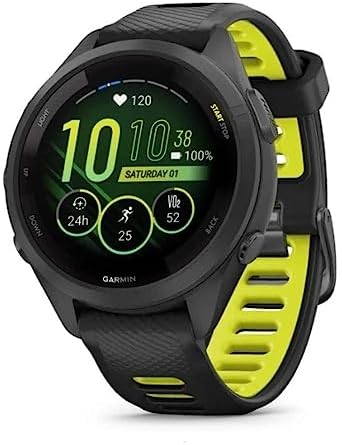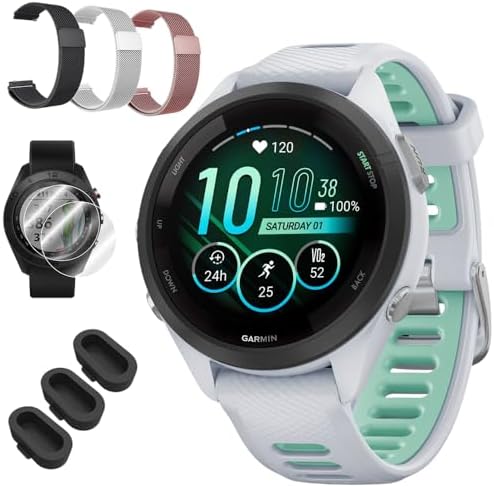
Selecting a GPS smartwatch often comes down to a fundamental question about how you train and where you roam. The Forerunner 265 series and the Instinct 3 collection represent two distinct answers to that question, one leaning into road-running performance and the other into rugged outdoor survival. Deciding between them is not a matter of one being better than the other in absolute terms, but of matching a device to a specific lifestyle. This guide treats the choice as a buyer’s decision, breaking down the dimensions that genuinely shape long-term satisfaction so the right model can be selected with confidence rather than guesswork.
| Feature & Selling Point | Garmin Forerunner 265 | Garmin Instinct 3 |
|---|---|---|
| Primary Design Goal | Lightweight road-running trainer | Rugged outdoor field watch |
| Case Size (Typical) | 42.0mm | 45mm |
| Weight | 37.2g | Approx. 55g (solar variant) |
| Display Technology | AMOLED touchscreen, 1.3-inch | AMOLED or monochrome Solar |
| Smartwatch Battery Life | Up to 13 days | Up to 15 days |
| GPS Battery Life | SatIQ up to 16 hours | Up to 42 hours GPS-only |
| Solar Charging | Not available | Available on Solar editions |
| Water Resistance | 5 ATM | 10 ATM |
| Durability Standard | Standard polymer case | MIL-STD 810 certified |
| Built-in Flashlight | No | Yes |
| Training & Recovery Suite | Full metrics, readiness, VO2 max | Standard activity tracking, HR |
| Music Storage | Phone-free music playback | Limited, varies by model |
| Navigation Type | Course navigation, breadcrumb | Multi-GNSS, ABC sensors |
| Best Suited For | Road runners and triathletes | Hikers, climbers, field personnel |

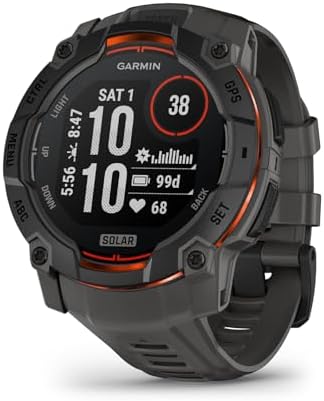
Best-Matched Comparison Picks
Garmin Instinct 3, 50mm rugged GPS smartwatch, Black/Charcoal band See Price on Amazon.co.ukThe table makes the divergence clear at a glance. The Forerunner 265 invests its engineering in lighter weight, richer running metrics, and a display built for glancing at pace during road intervals. The Instinct 3 directs its budget toward field-grade toughness, solar endurance, and multi-night GPS longevity. Neither approach is superior; they solve different problems. The sections below unpack what those trade-offs mean in real training and outdoor use, and where each model’s strengths become liabilities depending on the wearer’s priorities.
A Tale of Two Design Philosophies: Featherweight Pace versus Field-Ready Armor
The first thing a prospective buyer notices is the heft. At 37.2 grams in the 42.0mm case, the Forerunner 265 is engineered to disappear on the wrist during a tempo run, so light that its presence fades after the first kilometre. That weight discipline is deliberate; a runner glancing at heart-rate zones mid-interval does not want a device bouncing on the wrist. The polymer case and slim 12.6mm profile reinforce the idea that this watch is a tool for moving fast over paved surfaces, not for battering against rock faces.
Garmin positions the Instinct 3 collection very differently. According to Garmin, the lineup is built to MIL-STD 810 for thermal and shock resistance and is water-rated to 10 ATM, a specification that speaks to a life spent in streams, on cliffs, and in temperature extremes rather than on a treadmill. The 45mm case and reinforced bezel framing the monochrome or AMOLED display signal that this is a device meant to be worn, not pampered. For anyone who has cracked a screen against a rock or flooded a case in a river crossing, the Instinct 3’s durability credentials are not marketing garnish; they are the reason to consider it at all.
Battery Endurance and Charging: Days versus Hours
Battery architecture is where the two watches diverge most for anyone planning long outings. The Forerunner 265 offers up to 13 days in smartwatch mode and, per the Garmin specifications, roughly 16 hours in SatIQ auto-select GPS mode or up to 20 hours in GPS-only training. That is ample for weekly training blocks and the occasional half marathon, but it assumes a charging ritual every week or two. Runners who charge alongside their phone on a Sunday evening will never notice the limitation.
The Instinct 3 tells a different story. Garmin’s official comparison figures put smartwatch mode at up to 15 days and GPS-only operation at up to 42 hours without music, stretching to about 8.5 hours under the most demanding all-systems multi-band plus music scenario. On Solar editions, incremental top-ups extend usable time in bright conditions. This is the decisive variable for multi-day treks or ultra events where a single charge may need to cover 30-plus hours of continuous tracking. It also matters for anyone who resents a bedtime charging habit; the Instinct 3 leans further into set-and-forget endurance.
The Display Question: AMOLED Clarity versus Solar-Centric Legibility
The Forerunner 265 is defined in part by its 1.3-inch AMOLED touchscreen, a display that renders pace, maps, and recovery stats in vivid colour. Training metrics and phone-free music sit alongside that screen in the product’s positioning, and for road runners the combination of a bright, glanceable interface with structured workout guidance is a genuine workflow advantage. Recovery insights and training status are presented with enough visual clarity that absorbing a readiness score takes a second, not a squint.
Garmin offers the Instinct 3 in both AMOLED and monochrome solar variants, and that dual approach is itself a statement. The solar monochrome version prioritises sunlight-assisted charging and always-on legibility over colour, accepting a flatter visual experience in exchange for endurance and reduced power draw. The takeaway for buyers is straightforward: those who want vivid glanceability and touchscreen fluency lean toward the Forerunner 265, while those who value readability in direct glare and the option of energy harvesting lean toward a solar Instinct 3.
Built for Outdoor Navigation: Sensors That Earn Their Keep
The Instinct 3’s toolkit extends beyond durability. It includes a built-in flashlight, a feature that sounds minor until a trail time extends past dusk and a headlamp is back at the car. ABC sensors, namely altimeter, barometer, and compass, along with multi-GNSS support give hikers and climbers the situational awareness that a road-focused device only partially addresses. For summits, valley crossings, and backcountry navigation, these are the features that separate a field watch from a fitness tracker.
The Forerunner 265 counters with course navigation and breadcrumbs, sufficient for familiar trails and route following during long runs but not a substitute for full terrestrial navigation. A runner training for a destination marathon will find the Forerunner 265’s navigation adequate; a climber planning an approach in unfamiliar terrain will want the Instinct 3’s instrument suite. This is a case where intended terrain should drive the decision more than any single spec.
Which Watch Fits Which Wrist: A Buying Guide by User Type
The clearest way to decide is to match the device to the wearer. Road runners and triathletes who prioritise recovery metrics, structured intervals, and phone-free music should look at the Forerunner 265 lineup, where the training and recovery suite, AMOLED clarity, and 37.2g weight all align with performance on pavement. That coherence is the real argument for the model; every gram and every sensor serves the running archetype.
For those whose weekends involve rock and river, the rugged architecture of the Instinct line is the starting point. A solar-equipped, MIL-STD 810 build with 10 ATM water resistance and a built-in flashlight addresses a different set of failure modes, including cracked cases, dead batteries mid-traverse, and sudden darkness on the descent. The Instinct 3 range is where those field-readiness decisions live, and the solar variants in particular make sense for expeditions measured in days rather than hours.
Living With Each Watch: Real-World Trade-Offs
Ownership costs and daily rituals also differ. The Forerunner 265 asks for a weekly-ish charge and rewards that habit with a lightweight, unobtrusive daily companion that handles notifications, sleep tracking, and run reviews without feeling like hardware strapped to the wrist. The trade-off is limited ruggedness and the absence of solar backup, so a user who is hard on gear may find the polymer case ages faster than the internals deserve.
The Instinct 3 accepts a heavier wrist presence (the solar 45mm variant sits well above 50 grams) in exchange for endurance, field reliability, and a flashlight that becomes second nature. Its quieter display, especially on monochrome solar models, is a conscious cost paid for time between charges. Neither compromise is hidden; both are visible the moment the watch is strapped on, which is why trying the case size and weight before committing is advisable. The solar-capable variants of the Instinct 3 reward serious buyers with energy harvesting that extends intervals further than the rated figures suggest in bright conditions.
The Product-Level Choice: Two Concrete Prescriptions
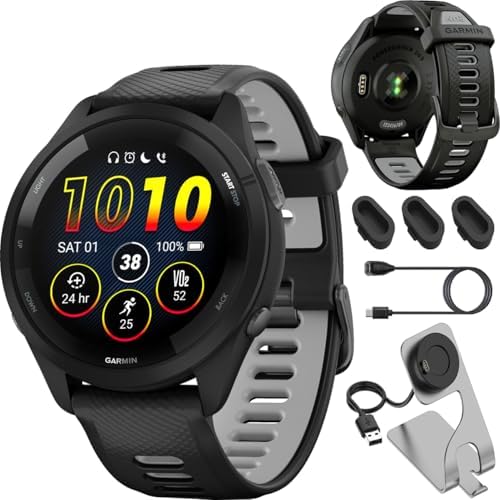
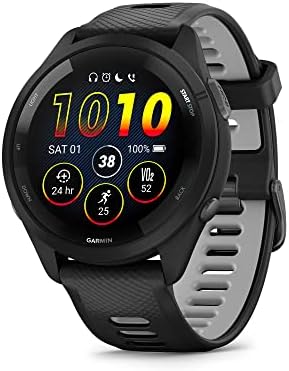
At the specific product level, the decision sharpens further. Runners who want the full training stack in a straightforward colourway can consider the Garmin Forerunner 265 in Black and Powder Gray, a configuration that pairs the AMOLED touchscreen with the training metrics and recovery insights described above, matched with a finish that reads comfortably in both workout and downtime settings.
For the outdoor counterpart, the Garmin Instinct 3 Solar 45mm rugged GPS smartwatch in Black carries the MIL-STD 810 resilience and 10 ATM water resistance in the larger 45mm format, with solar charging in a finish that suits field gear and uniform alike. It represents the rugged pole of the comparison in concrete form.
Brand Context and the Wider Garmin Ecosystem
Both models sit within a broader Garmin family that has long catered to distinct athletic and outdoor segments. Exploring the Garmin brand across its full catalogue reveals how deliberately the company partitions its offerings, and buyers who are unsure between the two archetypes often find the answer by examining adjacent lines rather than adhering to a single spec sheet. The ecosystem matters for resale and long-term use as well; neither watch becomes obsolete because the ecosystem alone dictates longevity as much as hardware.
Making the Final Decision: Criteria That Decide the Purchase
Buyers should deliberately rank their five most important criteria before purchasing. If the top answer is pace metrics and structured recovery guidance on paved routes, the Forerunner 265 is the natural choice. If the top answer is survival of the environment over days without a charge, a solar Instinct 3 is. If both are called upon in equal measure, the honest recommendation is that no single watch serves both masters perfectly, and the wearer must trade a little field ruggedness for running clarity or a little pace light for multi-day endurance.
Of the two, the Forerunner 265 is the more specialised tool, honed for running efficiency. The Instinct 3 remains the generalist that endures. Knowing which sentence describes a typical week is, in the end, the first and most accurate step in choosing between them.