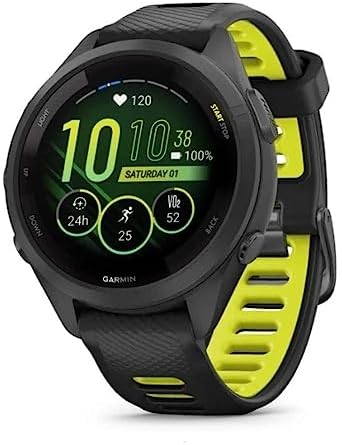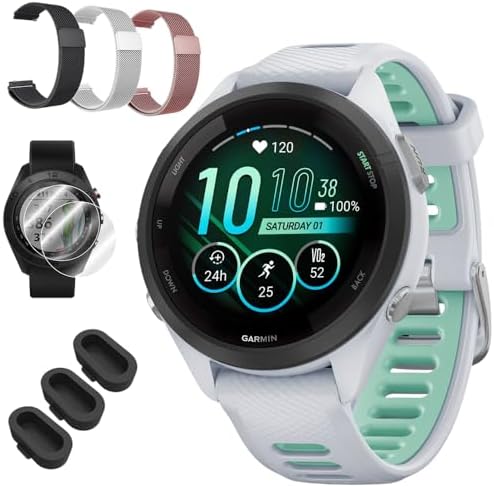
The Garmin Forerunner 265 series and the Venu 4 collection sit at two different points on the same family tree. One is a coaching tool built around structured running and triathlon work, the other is a daily wearable that folds health monitoring and lifestyle convenience into a similar AMOLED body. This comparison is written as a permanent buying reference: it sets out who should buy which watch, where the real trade-offs sit, and which specifications should decide the purchase rather than which model looks better on a spec sheet.
| Decision Factor | Garmin Forerunner 265 | Garmin Venu 4 |
|---|---|---|
| Core Design Intent | Structured run and triathlon coaching | All-day wellness and lifestyle tracking |
| Case Size | 43 mm | 45 mm |
| Weight | 40 g | 41 g |
| Display Type | AMOLED | AMOLED touchscreen |
| Smartwatch Battery Life | Up to 13 days | Up to 12 days |
| GPS-Only Battery Life | Up to 20 hours | Up to 18 hours |
| Training Readiness Score | Included | Not specified |
| Running Dynamics | Supported with accessory | Limited |
| ECG App | Not specified | Included |
| Built-in Flashlight | Not specified | Included |
| Sleep and Recovery Tracking | Advanced, feeds training advice | Sleep score with wellness focus |
| Sport Profiles | Triathlon and run focused | 80+ activity apps |
| Music Storage | Available on select models | Included |
| Best Suited To | Runners and triathletes | Everyday fitness and health users |

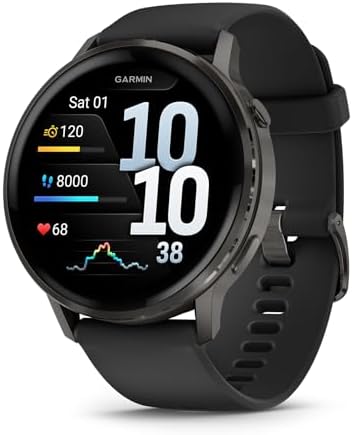
Two rows carry most of the decision weight. The Forerunner 265 holds the training-specific edge through its Training Readiness score and deeper running analytics, while the Venu 4 answers with an ECG app and a built-in flashlight that the running model does not list. Battery figures sit close enough that neither watch wins on endurance alone, which pushes the choice back to how the device will actually be used.
Who Should Buy the Forerunner 265
The Forerunner 265 is the right purchase for anyone whose week is organised around runs, interval sessions, or triathlon blocks. Its 43 mm case and 40 g weight are tuned to stay unobtrusive over long distances, and the button layout is designed for gloved or mid-stride operation. Garmin’s Training Readiness score pulls sleep quality, recovery time, and stress into a single daily recommendation, which turns the watch into a coach rather than a passive recorder. Runners who want to see ground contact time and vertical oscillation can pair the watch with a running dynamics accessory for the full data set.
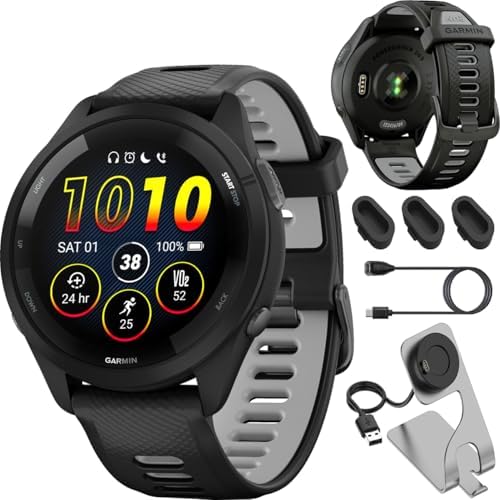
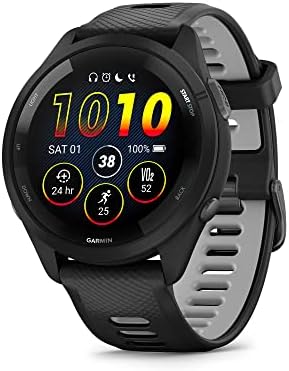
The trade-off is specialisation. Users who split their training across the gym, pool, and trail will find fewer lifestyle conveniences here, and the ECG and flashlight features that define the Venu 4 are not part of the Forerunner 265 specification. Buyers who want a single watch for structured run coaching and race-day pacing will find Garmin Forerunner 265 in Black and Powder Gray to be the most direct match for that brief.
Who Should Buy the Venu 4
The Venu 4 is the better fit for the buyer who wants one watch to cover a mixed routine. Its 45 mm case gives the AMOLED touchscreen more room, and the 80+ sport profiles comfortably cover gym sessions, cycling, swimming, and weekend hikes without pushing the user into a running-first interface. The ECG app adds a heart health layer that matters to buyers monitoring rhythm concerns, and the built-in flashlight is a genuinely practical addition for early starts and late finishes.
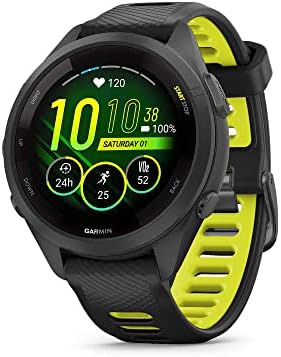
The trade-off runs in the opposite direction. Training Readiness and advanced running dynamics are not part of the Venu 4 feature set, so athletes chasing performance gains will find the coaching layer thinner. For buyers who prioritise health monitoring and daily utility over race preparation, the Garmin Venu 4 45mm – GPS Slate Black covers the broader brief.
Display, Build, and Wearing Comfort
Both watches use AMOLED panels, so the visual gap is smaller than the feature gap. The Forerunner 265 pairs its screen with a lighter 40 g build, which matters over marathon distances where every gram is felt at the wrist. The Venu 4 adds two millimetres of case diameter and a single gram of weight, a difference that is negligible in daily wear but noticeable to runners who prefer a compact profile.
Build decisions follow the same logic. The Forerunner 265 is shaped around sport-first ergonomics, with a bezel and strap setup intended to stay stable during high-cadence movement. The Venu 4 leans toward a more conventional everyday silhouette that transitions from the gym to the office without drawing attention. Neither approach is superior; the question is whether the watch will spend more time on a running track or in a meeting room.
Software Ecosystem and Health Features
The software split mirrors the hardware split. The Forerunner 265 is built around structured workouts, race predictions, and recovery guidance, with Training Readiness acting as the daily anchor. The Venu 4 is built around continuous health monitoring, with sleep scoring, an ECG app, and 80+ activity profiles feeding a broader wellness picture. Buyers who want to be told how hard to train should lean toward the Forerunner; buyers who want to understand how their body is behaving across the day should lean toward the Venu.
Both watches sync to the Garmin Connect app for activity review and data history, and both support music storage for phone-free sessions. The difference is emphasis rather than capability, which is why the purchase decision should be driven by the training question first and the feature checklist second.
The Criteria That Decide the Purchase
Three questions settle the choice. First, is the primary activity running or triathlon? If yes, the Training Readiness score and running dynamics support make the Forerunner 265 the more useful instrument. Second, does heart rhythm monitoring or a built-in flashlight matter for daily life? If yes, the Venu 4 covers ground the Forerunner does not. Third, does the buyer want a watch that coaches or a watch that informs? The Forerunner 265 sits firmly in the coaching camp, while the Venu 4 sits in the monitoring camp.
Battery life, display quality, and Garmin Connect support are close enough across both models that they should not drive the decision. Garmin’s Forerunner 265 lineup remains the specialist choice for athletes, and the Venu 4 remains the generalist choice for everyday health tracking. Buyers who answer the three questions honestly will land on the right watch without needing to compare every row of the specification table.
What separates these two models is not a gap in quality but a gap in intent. Garmin has built one watch to make runners faster and another to make daily health data easier to live with, and the Garmin brand’s decision to keep both lines in production reflects how differently people use wearable technology. The right purchase is the one that matches the routine the buyer actually has, not the routine they aspire to.